
Publications
Explore Our Comprehensive Research Outputs
Advancing AtmosphericScience Through Publications
APARC is dedicated to disseminating high-quality scientific knowledge in atmospheric and climate research. Our publications encompass a diverse range of materials, including comprehensive peer-reviewed assessment reports, biannual newsletters, and eNews bulletins issued every two months. We also feature journal publications and special issues prepared by researchers involved in APARC activities. These publications serve as valuable resources for the scientific community, policymakers, and the public, offering insights into the latest developments and findings in atmospheric sciences. Our assessment reports provide in-depth analyses on critical topics, while our newsletters and bulletins keep our audience informed about current research activities, meetings, workshops, and conferences. We invite you to explore our extensive collection of publications to stay informed and engaged with the advancements in atmospheric and climate science.
Comprehensive Analyses of Atmospheric Processes
Assessment Reports
APARC & SPARC comprehensive peer-reviewed assessment reports
APARC Reports: ISSN 3054-1549 (Print), ISSN 3054-1530 (Online)
SPARC Reports: ISSN 2296-5785 (Print), ISSN 2296-5793 (Online)
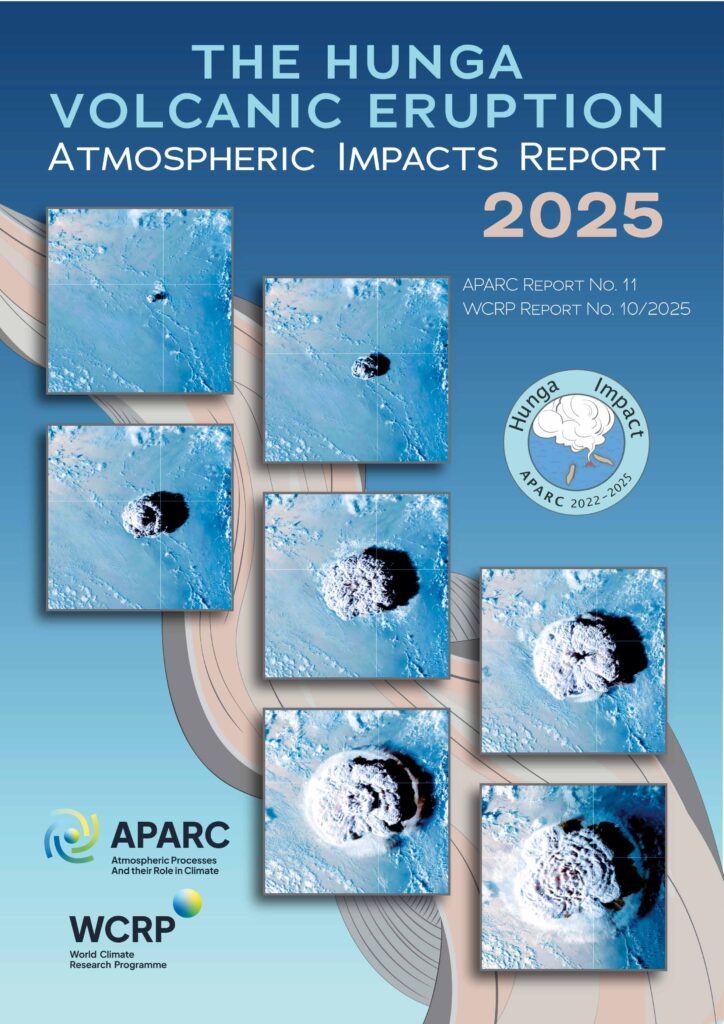
- APARC Report N°11 (2025):
The Hunga Volcanic Eruption Atmospheric Impacts Report - SPARC Report N°10 (2022):
SPARC Reanalysis Intercomparison Project (S-RIP) Final Report - SPARC Report N°9 (2019):
SPARC/IO3C/GAW Report on Long-term Ozone Trends and Uncertainties in the Stratosphere - SPARC Report N°8 (2017):
The SPARC Data Initiative: Assessment of stratospheric trace gas and aerosol climatologies from satellite limb sounders - SPARC Report N°7 (2016):
Solving the Mystery of Carbon Tetrachloride - SPARC Report N°6 (2013):
Lifetimes of Stratospheric Ozone-Depleting Substances - SPARC Report N°5 (2010):
Chemistry-Climate Model Validation - SPARC Report N°4 (2006):
Stratospheric Aerosol Properties - SPARC Report N°3 (2002):
Intercomparison of Middle Atmosphere Climatologies - SPARC Report N°2 (2000):
Upper Tropospheric and Stratospheric Water Vapour - SPARC Report N°1 (1998):
Trends in the Vertical Distribution of Ozon
Other reports of interest:
- Kurylo, M.J., B.-M. Sinnhuber et al. (2009) The Role of Halogen Chemistry in Polar Stratospheric Ozone Depletion.
Guidance for APARC reports
This guidance document includes recommendations from the APARC Office for authors and editors on how to get started and organised when preparing an APARC assessment report.
Stay Updated with the Latest Research and Activities
APARC Newsletter and eNews
The APARC newsletter is published biannually, offering in-depth updates on APARC-related research activities, meetings, workshops, and conferences. It features valuable contributions from the APARC community, highlighting the latest developments in atmospheric and climate science.
Our APARC eNews updates are published every two months by mail. These concise updates provide timely information on new website content, reminders for upcoming deadlines, and emerging opportunities for collaboration and engagement within the APARC network.
If you would like to subscribe to the newsletter and stay connected with APARC’s activities, you can easily reach out to the Forschungszentrum Jülich through the subscription form on our newsletter page. For ongoing updates, visit the „News“ section on our website to explore the latest highlights, announcements, and insights from the APARC community.

In-Depth Reports and Scientific Insights
Journal Publications
Explore APARC’s journal publications featuring cutting-edge research in atmospheric and climate science. These peer-reviewed articles highlight contributions from the APARC community, advancing our understanding of atmospheric processes and their impact on climate. Stay informed with the latest findings that shape scientific progress and global climate strategies.
Several activities have produced special journal issues. Find the full list here. For more journal publications, visit the activities section on our website.
Special journal issues are currently open for submissions for
- The SPARC Reanalysis Intercomparison (S-RIP) activity has a special issue in Atmospheric Chemistry and Physics: www.atmos-chem-phys.net/special_issue829.html
- The joint SPARC/IGAC Chemistry-Climate Model Initiative (CCMI) has a joint special issue in Atmospheric Chemistry and Physics, Atmospheric Measurement Techniques, Earth System Science Data, and Geoscientific Model Development: www.atmos-chem-phys.net/special_issue812.html.
- The WAVAS-II activity has a joint special issue in Atmospheric Chemistry and Physics, Atmospheric Measurement Techniques, and Earth System Science Data: www.atmos-chem-phys.net/special_issue830.html
- The TUNER activity has a special issue in Atmospheric Measurement Techniques: https://www.atmos-meas-tech.net/special_issue921.html
The SNAP & QBOi activities have a special issue in Copernicus journals (WCD/GMD inter-journal SI): Stratospheric impacts on climate variability and predictability in nudging experiments: https://wcd.copernicus.org/articles/special_issue1297.html
Ozone profile trends
The SPARC/IO3C/IGACO-O3/NDACC (SI2N) initiative produced over 50 journal articles in a joint Atmospheric Chemistry and Physics/Atmospheric Measurement Techniques/Earth System Science Data special issue. The full list of articles can be found here.
Atmospheric Composition and the Asian Summer Monsoon (ACAM)
- Randel, W. J., Laura, L., and J. Bian, 2016: Workshop on dynamics, transport and chemistry of the UTLS Asian Monsoon. Advances in Atmospheric Sciences, 33(9), pp 1096–1098.
Assessing Predictability (SNAP)
- Hitchcock, P., Butler, A., Charlton-Perez, A., Garfinkel, C.I., Stockdale, T., Anstey, J., et al., 2022: Stratospheric Nudging And Predictable Surface Impacts (SNAPSI): a protocol for investigating the role of stratospheric polar vortex disturbances in subseasonal to seasonal forecasts. Geoscientific Model Development, 15(13), 5073–5092. doi: 10.5194/gmd-15-5073-2022.
- Lawrence, Z.D., Abalos, M., Ayarzagüena, B., Barriopedro, D., Butler, A.H., Calvo, N., de la Cámara, A., Charlton-Perez, A., Domeisen, D.I., Dunn-Sigouin, E. and García-Serrano, J., 2022. Quantifying stratospheric biases and identifying their potential sources in subseasonal forecast systems. Weather and Climate Dynamics Discussions, 2022, pp.1-37.
- Domeisen, D. et al. (2019): The role of the stratosphere in subseasonal to seasonal prediction Part I: Predictability of the stratosphere. Journal of Geophysical Research: Atmospheres, 124. DOI: 10.1029/2019JD030920.
- Domeisen, D. I. V., Butler, A. H., Charlton‐Perez, A. J., Ayarzagüena, B., Baldwin, M. P., Dunn‐Sigouin, E., et al ( 2019). The role of the stratosphere in subseasonal to seasonal prediction Part II: Predictability arising from stratosphere ‐ troposphere coupling. Journal of Geophysical Research: Atmospheres, 124. DOI: 0.1029/2019JD030923.
- Butler, A.H., et al., Sub-seasonal Predictability and the Stratosphere- Chapter 11, The Gap Between Weather and Climate Forecasting, p. 223-241, Elsevier, https://doi.org/10.1016/B978-0-12-811714-9.00011-5, 2019.
- Tripathi, O.P., et al., 2014: The predictability of the extratropical stratosphere on monthly time-scales and its impact on the skill of tropospheric forecasts. Q.J.R. Meteorol. Soc.. doi: 10.1002/qj.2432
CCM validation
Find full publication list at http://www.pa.op.dlr.de/CCMVal/CCMVal_publications.html
- Morgenstern, O. et al. (2017): Review of the global models used within phase 1 of the Chemistry–Climate Model Initiative (CCMI), Geosci. Model Dev., 10, 639–671, DOI: 10.5194/gmd-10-639-2017.
- Butchart, N., et al. (2011) Multimodel climate and variability of the stratosphere. Journal of Geophysical Research – Atmosphere 116, D05102, DOI: 10.1029/2010JD014995.
- Austin, J., et al. (2008) Coupled chemistry climate model simulations of the solar cycle in ozone and temperature. J. Geophys. Res., 113, D11306
- Duncan, B.N., A. Gettelman, P. Hess, G. Myhre, and P. Young (eds.), 2016: Chemistry–Climate Modelling Initiative (CCMI) (ACP/AMT/ESSD/GMD inter-journal SI). Special issue Atmos. Chem. Phys.
- Eyring V., et al. (2005) A strategy for process-oriented validation of coupled chemistry-climate models. Bull. Am. Meteorol. Soc., 86, 1117–1133
- Eyring, V., et al. (2006) Assessment of temperature, trace species and ozone in chemistry-climate model simulations of the recent past. J. Geophys. Res., 111, D22308, doi:10.1029/2006JD007327
- Eyring, V., et al. (2007) Multimodel projections of stratospheric ozone in the 21st century. J. Geophys. Res., 112, D16303, doi:10.1029/2006JD008332
- Gettelman, A., et al. (2009) The Tropical Tropopause Layer 1960–2100. Atmos. Chem. Phys., 9, 1621-1637
- Son, S.-W., et al. (2008) The Impact of Stratospheric Ozone Recovery on the Southern Hemisphere Westerly Jet. Science, 320, DOI: 10.1126/science.1155939
- Son, S.-W., et al. (2009) Future tropopause trends as simulated by stratosphere-resolving chemistry-climate models. J. Clim., 22, 429-455
- Tourpali, K., et al. (2009) Clear sky UV simulations in the 21st century based on Ozone and Temperature Projections from Chemistry-Climate Models. Atmos. Chem. Phys., 9, 1165-1172
- Waugh, D. W. and V. Eyring (2008) Quantitative performance metrics for stratospheric-resolving chemistry-climate models. Atmos. Chem. Phys., 8, 5699-5713
Dynamical Variability
- Gerber, E. P. and E. Manzini, 2016: The Dynamics and Variability Model Intercomparison Project (DynVarMIP) for CMIP6: assessing the stratosphere–troposphere system. Geosci. Model Dev., 9, 3413-3425
- Kidston J., et al., 2015: Stratospheric influence on tropospheric jet streams, storm tracks and surface weather. Nat. Geosci., 8, 433-450
- Barnes, E.A., N.W. Barnes and L.M. Polvani, 2014: Delayed Southern Hemisphere climate change induced by stratospheric ozone recovery, as projected by the CMIP5 models. J. Climate, 27, 852-867.
- Gerber, E. P. and S.-W. Son, 2014: Quantifying the Summertime Response of the Austral Jet Stream and Hadley Cell to Stratospheric Ozone and Greenhouse Gases. J. Climate, 27, 5538-5559, doi: 10.1175/JCLI-D-13-00539.1
- Lott, F. et al., 2014: Kelvin and Rossby-gravity wave packets in the lower stratosphere of some high-top CMIP5 models. JGR Atmos., 119, 2156–2173, doi: 10.1002/2013JD020797
- Manzini, E. et al., 2014: Northern winter climate change: Assessment of uncertainty in CMIP5 projections related to stratosphere-troposphere coupling. JGR Atmos., 119, doi: 10.1002/2013JD021403
- Neely, R.R., et al., 2014: Biases in Southern Hemisphere climate trends induced by coarsely specifying the temporal resolution of stratospheric ozone. Geophys. Res. Lett., 41, doi:10.1002/2014GL061627
- Scaife, A.A., et al., 2014: Predictability of the quasi-biennial oscillation and its northern winter teleconnection on sea- sonal to decadal timescales. Geophys. Res. Lett., 41, 1752–1758, doi:10.1002/ 2013GL059160.
- Seviour W.J.M., et al., 2014: Skillful seasonal prediction of the Southern Annular Mode and Antarctic ozone. J. Clim., 27, 7462-7474, DOI: 10.1175/JCLI-D-14-00264.1.
- Shaw, T.A., J. Perlwitz, and O. Weiner, 2014: Troposphere-stratosphere coupling: Links to North Atlantic weather and climate, including their representation in CMIP5 models. J. Geophys. Res., 10.1002/2013JD021191
- Simpson, I.R., T.A. Shaw, and R. Seager, 2014: A Diagnosis of the Seasonally and Longitudinally Varying Midlatitude Circulation Response to Global Warming. J. Atmos. Sci., 71, 2489-2514, DOI: 10.1175/JAS-D-13-0325.1
- Kawatani, Y., and K. Hamilton (2013) Weakened stratospheric quasibiennial oscillation driven by increased tropical mean upwelling. Nature 497, doi:10.1038/nature12140 See alsocorrigendum.
- Hardiman, S.C., N. Butchart, and N. Calvo (2013) The morphology of the Brewer–Dobson circulation and its response to climate change in CMIP5 simulations. Q.J.R. Meteorol. Soc., DOI: 10.1002/qj.2258
- Charlton-Perez, A.J., et al. (2013) On the lack of stratospheric dynamical variability in low-top versions of the CMIP5 models. J. Geophys. Res. Atmos., 118, 2494–2505, doi:10.1002/jgrd.50125
- Reichler, T., J. Kim, E. Manzini, and J. Kröger (2012) A stratospheric connection to Atlantic climate variability. Nature Geoscience, Letters, 5, 783-787. DOI 10.1038/ngeo1586.http://www.nature.com/ngeo/journal/vaop/ncurrent/full/ngeo1586.html
- Gerber, E.P., et al. (2012) Assessing and Understanding the Impact of Stratospheric Dynamics and Variability on the Earth System. Bulletin of the American Meteorological Society 93: 845-859.
Trace gas climatologies (SPARC Data Initiative)
- Tegtmeier, S., et al. (2013) The SPARC Data Initiative: A comparison of ozone climatologies from international satellite limb sounder. J. Geopyhs. Res., DOI: 10.1002/2013JD019877.
- Hegglin, M.I., et al. (2013) SPARC Data Initiative: Comparison of water vapor climatologies from international satellite limb sounders. J. Geopyhs. Res., DOI: 10.1002/jgrd.50752.
Gravity waves
- de la Cámara, A. and F. Lott, 2015: A parameterization of gravity waves emitted by fronts and jets. Geophys. Res. Lett., 42, doi:10.1002/2015GL063298.
- Plougonven, R., A. Hertzog, and M. J. Alexander, 2015: Case studies of nonorographic gravity waves over the Southern Ocean emphasize the role of moisture. J. Geophys. Res., 120, 1278-1299.
- Sato, K. and M. Nomoto, 2015: Gravity wave-induced anomalous potential vorticity gradient generating planetary waves in the winter mesosphere. J. Atmos. Sci., 72, 3609-3624. doi: dx.doi.org/10.1175/JAS-D-15‐0046.1
- Scheffler, G., and M. Pulido, 2015: Compensation between resolved and unresolved wave drag in the stratospheric final warnings of the Southern Hemisphere. J. Atmos. Sci., 72, doi: dx.doi.org/10.1175/JAS‐D-14‐0270.1
- Geller, M.A., et al. (2013) Comparison between Gravity Wave Momentum Fluxes in Observations and Climate Models. Journal of Climate (ahead of print)
- Alexander, M.J., et al. (2010) Recent Developments on Gravity Wave Effects in Climate Models, and the Global Distribution of Gravity Wave Momentum Flux from Observations and Models. Q. J. Roy. Meteorol. Soc., 136, 1103-1124.
Polar Stratospheric Clouds
- Snels, M., et al.: Comparison of Antarctic polar stratospheric cloud observations by ground-based and spaceborne lidars and relevance for Chemistry Climate Models, Atmos. Chem. Phys. Discuss., https://doi.org/10.5194/acp-2018-589, in review, 2018.
- Tritscher, I., et al.: Lagrangian simulation of ice particles and resulting dehydration in the polar winter stratosphere, Atmos. Chem. Phys. Discuss., https://doi.org/10.5194/acp-2018-337, in review, 2018.
- Höpfner, M., et al.: The MIPAS/Envisat climatology (2002–2012) of polar stratospheric cloud volume density profiles, Atmos. Meas. Tech., 11, 5901-5923, https://doi.org/10.5194/amt-11-5901-2018, 2018.
- Pitts, M. C., Poole, L. R., and Gonzalez, R.: Polar stratospheric cloud climatology based on CALIPSO spaceborne lidar measurements from 2006 to 2017, Atmos. Chem. Phys., 18, 10881-10913, https://doi.org/10.5194/acp-18-10881-2018, 2018.
- Grooß, J.-U., et al.: On the discrepancy of HCl processing in the core of the wintertime polar vortices, Atmos. Chem. Phys., 18, 8647-8666, https://doi.org/10.5194/acp-18-8647-2018, 2018.
- Spang, R., et al.: A climatology of polar stratospheric cloud composition between 2002 and 2012 based on MIPAS/Envisat observations, Atmos. Chem. Phys., 18, 5089-5113, https://doi.org/10.5194/acp-18-5089-2018, 2018.
- Spang, R., et al.: A multi-wavelength classification method for polar stratospheric cloud types using infrared limb spectra, Atmos. Meas. Tech., 9, 3619-3639, https://doi.org/10.5194/amt-9-3619-2016, 2016.
- Lambert, A., Santee, M. L., and Livesey, N. J.: Interannual variations of early winter Antarctic polar stratospheric cloud formation and nitric acid observed by CALIOP and MLS, Atmos. Chem. Phys., 16, 15219-15246, https://doi.org/10.5194/acp-16-15219-2016, 2016.
Solar influence
- Matthes, K., et al., 2017: Solar Forcing for CMIP6 (v3.2). Geosci. Model Dev., 10, doi:10.5194/gmd-10-2247-2017.
- Funke, B., et al., 2017: HEPPA-II model-measurement intercomparison project: EPP indirect effects during the dynamically perturbed NH winter 2008-2009, Atmos. Chem. Phys., 17, 3573-3604, doi:10.5194/acp-17-3573-2017.
- Gillett, N.P., et al., 2016: Detection and Attribution Model Intercomparison Project (DAMIP). Geosci. Model Dev., doi:10.5194/gmd-2016-74.
- Kodera, K., Thiéblemont, R., Yukimoto, S., and Matthes, K., 2016: How can we understand the global distribution of the solar cycle signal on the Earth’s surface? Atmos. Chem. Phys. 16, 12925-12944, doi:10.5194/acp-16-12925-2016.
- Misios, S., et al., 2015: Solar Signals in CMIP-5 Simulations: Effects Atmosphere-Ocean Coupling, Q. J. Roy. Met. Soc., 142, doi:10.1002/qj.2695.
- Hood, L., et al., 2015: Solar Signals in CMIP-5 Simulations: The Ozone Response. Q. J. Roy. Met. Soc., DOI 10.1002/qj.2553.
- Mitchell, D., et al., 2015: Solar Signals in CMIP-5 Simulations: The Stratospheric Pathway. Q. J. Roy. Met. Soc, doi:10.1002/qj.2530.
- Thiéblemont, R., K. Matthes, N. Omrani, K. Kodera, and F. Hansen, 2015: Solar forcing synchronizes decadal North Atlantic climate variability. Nat. Comm., doi: 10.1038/ncomms9268.
- Ermolli, I., et al. (2012) Recent variability of the solar spectral irradiance and its impact on climate modelling. Atmos. Chem. Phys. Discuss., 12, 24557-24642, doi:10.5194/acpd-12-24557-2012
- Funke, B., et al. (2011) Composition changes after the “Halloween” solar proton event: the High-Energy Particle Precipitation in the Atmosphere (HEPPA) model versus MIPAS data intercomparison study. Atmos. Chem. Phys., Vol. 11(3), 9089-9139.
- Gray, L.J., et al. (2010) Solar Influences on Climate. Rev. Geophys., 48, RG4001, doi:10.1029/2009RG000282.
- Manzini, E., and K. Matthes et al. (2010) Natural Variability of Stratospheric Ozone, Chapter 8 in SPARC CCMVal, SPARC CCMVal Report on the Evaluation of Chemistry-Climate Models, V. Eyring, T. G. Shepherd, D. W. Waugh (Eds.) SPARC Report No. 5, WCRP-X, WMO/TD-No. X, 2010.
- Austin, J., et al. (2008) Coupled chemistry climate simulations of the solar cycle in temperature and ozone. Journal of Geophysical Research 113, D11306, doi: 10.1029/2007JD009391.
Find more science articles at http://sparcsolaris.gfz-potsdam.de/publications.php.
Quasi-biennial oscillation
- Butchart, N. et al., 2018. Overview of experiment design and comparison of models participating in phase 1 of the SPARC Quasi-Biennial Oscillation initiative (QBOi). Geoscientific Model Development, 11, 1009-1032, 10.5194/gmd-11-1009-2018.
- Rajendran K., I. M. Moroz, S. M. Osprey, and P. L. Read, 2018: Descent rate models of the synchronization of the Quasi-Biennial Oscillation by the annual cycle in tropical upwelling. J. Atmos. Sci., 10.1175/JAS-D-17-0267.1
- Watanabe S., et al., 2018: First Successful Hindcasts of the 2016 Disruption of the Stratospheric Quasi-biennial Oscillation. Geophys. Res. Lett., 45(3), 10.1002/2017GL076406.
- Osprey, S., Geller M., and Yoden S., 2018: The stratosphere and its role in tropical teleconnections. Eos. 2018 99, 10.1029/2018EO097387.
- Schenzinger V., Osprey S., Gray L., and Butchart N.: Defining metrics of the Quasi-Biennial Oscillation in global climate models. Geosci Model Dev., 8 Jun 2017, 10(6):2157-68, DOI: 10.5194/gmd-10-2157-2017
- Osprey, S.M., et al., 2016: An unexpected disruption of the atmospheric quasi-biennial oscillation. Science, 08 Sep 2016, DOI: 10.1126/science.aah4156
- Rajendran K., I.M. Moroz, P.L. Read and S.M. Osprey, 2016: Synchronisation of the equatorial QBO by the annual cycle in tropical upwelling in a warming climate. Q. J. R. Meteorol. Soc., DOI: 10.1002/qj.2714
- Hamilton, K., S. Osprey, and N. Butchart, 2015: Modeling the stratosphere’s “heartbeat,” EOS, 96, doi:10.1029/2015EO032301.
- Baldwin, M.P., et al. (2001) The quasi-biennial oscillation. Reviews of Geophysics 39(2), pp. 179-229.
Geo-engingeering
- Kravitz, B., et al. (2011) The geo-engineering model intercomparison project (GeoMIP). Atmospheric Science Letters 12, 162-167, doi:10.1002/asl.316.
- Robock, A., B. Kravitz, and O. Boucher (2011) Standardizing experiments in geoengineering: GeoMIP stratospheric aerosol geoengineering workshop. Eos 92(23), 197-198, doi:10.1029/2011EO230008.
- Kravitz, B., A. Robock, O. Boucher, H. Schmidt, and K. E. Taylor (2011) Specifications for GeoMIP experiments G1 through G4. (Frozen: Version 1.0)
- Fujiwara, M. et al., 2017: Introduction to the SPARC Reanalysis Intercomparison Project (S-RIP) and overview of the reanalysis systems. Atmos. Chem. Phys. 17, 1417-1452, doi: 10.5194/acp-17-1417-2017.
- Long, C. S. et al., 2017: Climatology and interannual variability of dynamic variables in multiple reanalyses evaluated by the SPARC Reanalysis Intercomparison Project (S-RIP). Atmos. Chem. Phys. 17, 14593-14629, doi: 10.5194/acp-17-14593-2017.
- Davis, S. M. et al., 2017: Assessment of upper tropospheric and stratospheric water vapour and ozone in reanalyses as part of S-RIP. Atmos. Chem. Phys. 17, 12743-12778, doi: 10.5194/acp-17-12743-2017.
Stratospheric Sulfur (SSiRC)
- Thomason, L. W., et al. (2018). “A global space-based stratospheric aerosol climatology: 1979–2016.” Earth System Science Data 10(1): 469-492. https://doi.org/10.5194/essd-10-469-2018
- Timmreck, C., et al. (2018) “The Interactive Stratospheric Aerosol Model Intercomparison Project (ISA-MIP): motivation and experimental design.” Geosci. Model Dev., 11, 2581-2608, https://doi.org/10.5194/gmd-11-2581-2018”. https://doi.org/10.5194/gmd-11-2581-2018
- Kremser, S. et al. (2016): Stratospheric aerosol—Observations, processes, and impact on climate, Rev. Geophys., 54, 278– 335, DOI: 10.1002/2015RG000511
- Deshler, T., R. Anderson-Sprecher, H. Jäger, et al., Trends in the non-volcanic component of stratospheric aerosol over the period 1971–2004, J. Geophys. Res., 111, D01201 (2006)
Temperature changes (previous temperature trends activity)
- Maycock, A. C., et al. (2018): Revisiting the mystery of recent stratospheric temperature trends. Geophysical Research Letters, 45, 9919– 9933. DOI: 10.1029/2018GL078035.
- Ding, Q., & Fu, Q. (2017). A warming tropical central Pacific dries the lower stratosphere. Climate Dynamics. https://doi.org/10.1007/s00382-017-3774-y
- Funatsu, B. M., Claud, C., Keckhut, P., Hauchecorne, A., & Leblanc, T. (2016). Regional and seasonal stratospheric temperature trends in the last decade (2002–2014) from AMSU observations. Journal of Geophysical Research: Atmospheres, 2015JD024305. https://doi.org/10.1002/2015JD024305
- Garfinkel, C.I., Son, S.-W., Song, K., Aquila, V., & Oman, L. D. (2017). Stratospheric variability contributed to and sustained the recent hiatus in Eurasian winter warming. Geophysical Research Letters, 44(1), 2016GL072035. https://doi.org/10.1002/2016GL072035
- Hauchecorne, A. et al. (2018). A new MesosphEO dataset of temperature profiles from 35 to 85 km using Rayleigh scattering at limb from GOMOS/ENVISAT daytime observations. Atmospheric Measurement Techniques Discussion,https://doi.org/10.5194/amt-2018-241
- Ho, S.-P., Peng, L., & Vömel, H. (2017). Characterization of the long-term radiosonde temperature biases in the upper troposphere and lower stratosphere using COSMIC and Metop-A/GRAS data from 2006 to 2014. Atmospheric Chemistry and Physics, 17(7), 4493–4511. https://doi.org/10.5194/acp-17-4493-2017
- Ivy, D. J., Solomon, S., & Rieder, H. E. (2015). Radiative and Dynamical Influences on Polar Stratospheric Temperature Trends. Journal of Climate. https://doi.org/10.1175/JCLI-D-15-0503.1
- Ivy, D. J., Solomon, S., Calvo, N., & Thompson, D. W. J. (2017). Observed connections of Arctic stratospheric ozone extremes to Northern Hemisphere surface climate. Environmental Research Letters, 12(2), 024004
- Khaykin, S. M., Funatsu, B. M., Hauchecorne, A., Godin-Beekmann, S., Claud, C., Keckhut, P., et al. (2017). Postmillennium changes in stratospheric temperature consistently resolved by GPS radio occultation and AMSU observations. Geophysical Research Letters, 44(14), 2017GL074353. https://doi.org/10.1002/2017GL074353
- Li, J., Thompson, D. W. J., Barnes, E. A., & Solomon, S. (2017). Quantifying the Lead Time Required for a Linear Trend to Emerge from Natural Climate Variability. Journal of Climate. https://doi.org/10.1175/JCLI-D-16-0280.1
- Long, C. S., Fujiwara, M., Davis, S., Mitchell, D. M., & Wright, C. J. (2017). Climatology and interannual variability of dynamic variables in multiple reanalyses evaluated by the SPARC Reanalysis Intercomparison Project (S-RIP). Atmos. Chem. Phys., 17(23), 14593–14629. https://doi.org/10.5194/acp-17-14593-2017
- Maycock, A. C. (2016). The contribution of ozone to future stratospheric temperature trends. Geophysical Research Letters, 2016GL068511. https://doi.org/10.1002/2016GL068511
- Maycock, A. C., & Hitchcock, P. (2015). Do split and displacement sudden stratospheric warmings have different annular mode signatures? Geophysical Research Letters, 2015GL066754. https://doi.org/10.1002/2015GL066754
- Maycock, A. C., et al. (2018). Revisiting the mystery of recent stratospheric temperature trends. Geophysical Research Letters. https://doi.org/10.1029/2018GL078035 (Frontier article).
- McLandress, C., et al. (2015). A method for merging nadir-sounding climate records, with an application to the global-mean stratospheric temperature data sets from SSU and AMSU. Atmospheric Chemistry and Physics, 15(16), 9271–9284. https://doi.org/10.5194/acp-15-9271-2015
- Mears, C. A., & Wentz, F. J. (2017). A Satellite-Derived Lower-Tropospheric Atmospheric Temperature Dataset Using an Optimized Adjustment for Diurnal Effects. Journal of Climate, 30(19), 7695–7718. https://doi.org/10.1175/JCLI-D-16-0768.1
- Ming, A., Maycock, A. C., Hitchcock, P., & Haynes, P. (2017). The radiative role of ozone and water vapour in the annual temperature cycle in the tropical tropopause layer. Atmos. Chem. Phys., 17(9), 5677–5701. https://doi.org/10.5194/acp-17-5677-2017
- Nash, J., & Saunders, R. (2013). A review of Stratospheric Sounding Unit radiance observations in support of climate trends investigations and reanalysis (Met Office Technical Report No. 586) (pp. 58).
- Nash, J., & Saunders, R. (2015). A review of Stratospheric Sounding Unit radiance observations for climate trends and reanalyses. Quarterly Journal of the Royal Meteorological Society, 141(691), 2103–2113. https://doi.org/10.1002/qj.2505
- Polvani, L. M., Abalos, M.; Garcia, R., Kinnison, D. & Randel, W. J. (2018). Significant weakening of Brewer-Dobson circulation trends over the 21st century as a consequence of the Montreal Protocol. Geophys. Res. Lett., 45, 401–409. https://doi.org/10.1002/2017GL075345
- Polvani, L.M., et al. (2018). The impact of ozone-depleting substances on tropical upwelling, as revealed by the absence of lower-stratospheric cooling since the late 1990s. J. Climate, 30, 2523–2534. https://doi.org/10.1175/JCLI-D-16-0532
- Randel, W.J., et al. (2016). Stratospheric temperature trends over 1979-2015 derived from combined SSU, MLS and SABER satellite observations. Journal of Climate. https://doi.org/10.1175/JCLI-D-15-0629.1
- Randel, W.J., et al. (2017). Troposphere-Stratosphere Temperature Trends Derived From Satellite Data Compared With Ensemble Simulations From WACCM. Journal of Geophysical Research: Atmospheres, 122(18), 2017JD027158. https://doi.org/10.1002/2017JD027158
- Randel, W. J. (2018). The seasonal fingerprint of climate change. Science, 361, 227–228. doi:10.1126/science.aat9097
- Santer, B.D., Solomon, S., Pallotta, G., Mears, C., Po-Chedley, S., Fu, Q., et al. (2016). Comparing tropospheric warming in climate models and satellite data. Journal of Climate. https://doi.org/10.1175/JCLI-D-16-0333.1
- Santer, B.D., Fyfe, J.C., Pallotta, G., Flato, G.M., Meehl, G.A., England, M.H., et al. (2017). Causes of differences in model and satellite tropospheric warming rates. Nature Geosci, 10(7), 478–485
- Santer, B. D., Solomon, S., Wentz, F. J., Fu, Q., Po-Chedley, S., Mears, C., et al. (2017). Tropospheric Warming Over The Past Two Decades. Scientific Reports, 7(1), 2336. https://doi.org/10.1038/s41598-017-02520-7
- Santer, B.D., et al. (2018). Human influence on the seasonal cycle of tropospheric temperature. Science, 361(6399), eaas8806. https://doi.org/10.1126/science.aas8806
- Scherllin-Pirscher, B., Randel, W. J., & Kim, J. (2017). Tropical temperature variability and Kelvin-wave activity in the UTLS from GPS RO measurements. Atmospheric Chemistry and Physics, 17(2), 793–806. https://doi.org/10.5194/acp-17-793-2017
- Schmidt, T., et al. (2016). UTLS temperature validation of MPI-ESM decadal hindcast experiments with GPS radio occultations. Meteorologische Zeitschrift, 25(6), 673–683. https://doi.org/10.1127/metz/2015/0601
- Seidel, D.J., Li, J., Mears, C., Moradi, I., Nash, J., Randel, W.J., et al. (2016). Stratospheric temperature changes during the satellite era. Journal of Geophysical Research: Atmospheres, 121(2), 2015JD024039. https://doi.org/10.1002/2015JD024039
- Shultz, D. (2018), Satellite observations validate stratosphere temperature models, Eos, https://doi.org/10.1029/2018EO109113, published on 21 November 2018.
- Steiner, A. K., Lackner, B. C., & Ringer, M. A. (2018). Tropical convection regimes in climate models: evaluation with satellite observations. Atmospheric Chemistry and Physics, 18, 4657–4672, https://doi.org/10.5194/acp-18-4657-2018
- Thompson, D.W.J., Seidel, D.J., Randel, W.J., Zou, C.-Z., Butler, A.H., Mears, C., et al. (2012). The mystery of recent stratospheric temperature trends. Nature, 491(7426), 692–697. https://doi.org/10.1038/nature11579
- Wilhelmsen, H., Ladstädter, F., Scherllin-Pirscher, B., & Steiner, A. K. (2018). Atmospheric QBO and ENSO indices with high vertical resolution from GNSS radio occultation temperature measurements. Atmos. Meas. Tech., 11(3), 1333–1346. https://doi.org/10.5194/amt-11-1333-2018
- Zou, C.-Z., Qian, H., Wang, W., Wang, L., & Long, C. (2014). Recalibration and merging of SSU observations for stratospheric temperature trend studies. Journal of Geophysical Research: Atmospheres, 119(23), 2014JD021603. https://doi.org/10.1002/2014JD021603
- Zou, C.-Z., & Qian, H. (2016). Stratospheric Temperature Climate Data Record from Merged SSU and AMSU-A Observations. Journal of Atmospheric and Oceanic Technology, 33(9), 1967–1984. https://doi.org/10.1175/JTECH-D-16-0018.1
- Zou, C.-Z., Goldberg, M. D., & Hao, X. (2018). New generation of U.S. satellite microwave sounder achieves high radiometric stability performance for reliable climate change detection. Science Advances, 4(10), eaau0049. https://doi.org/10.1126/sciadv.aau0049
- Keckhut, P., et al. (2011) An evaluation of uncertainties in monitoring middle atmosphere temperatures with the lidar network in support of space observation. Journal of Atmospheric and Solar-terrestrial Physics, 73(5-6), 627-642, doi: 10.1016/j.jastp.2011.01.003
- Seidel, D.J., N.P. Gillet, J.R. Lanzante, K.P. Shine, and P.W. Thorne (2011) Stratospheric temperature trends: our evolving understanding. Climate Change 2(4), pp. 592-616
- Randel, W.J., et al. (2009) An update of observed stratospheric temperature trends. Journal of Geophysical Research 114, D02107, DOI: 10.1029/2008JD010421
- Austin, J., et al. (2009) Coupled chemistry climate model simulations of stratospheric temperatures and their trends for the recent past. Geophysical Research Letters 36, L13809, DOI: 10.1029/2009GL038462
- Shine, K.P., J. Barnett John, and W.J. Randel (2008) Temperature trends derived from Stratospheric Sounding Unit radiances: The effect of increasing CO2 on the weighting function. GEOPHYSICAL RESEARCH LETTERS 35(2), DOI: 10.1029/2007GL032218
- Ramaswamy, V., et al. (2001) Stratospheric temperature trends: Observations and model simulations. REVIEWS OF GEOPHYSICS 39 (1), pp. 71-122, DOI: 10.1029/1999RG000065
- Shine, K.P., et al. (2003) A comparison of model-simulated trends in stratospheric temperatures. Quarterly Journal of the Royal Meteorological Society (Q.J.R. Meteorol. Soc.), 129 (590), pp. 1565-1588.
Water vapour (I)
- Rosenlof, K.H., S.J. Oltmans, D. Kley, J.M. Russell III, E.-W. Chiou, W.P. Chu, D.G. Johnson, K.K. Kelly, H.A. Michelsen, G.E. Nedoluha, E.E. Remsberg, G.C. Toon, M.P. McCormick (2001)Stratospheric water vapour increases over the past half-century. Geophysical Research Letters 28(7), pp. 1195-1198, DOI: 10.1029/2000GL012502.
GRIPS
- Butchart, N., et al. (2006) Simulations of anthropogenic change in the strength of the Brewer-Dobson circulation. Climate Dynamics 27, pp. 727-741.
- Matthes, K., et al. (2003) GRIPS solar experiments intercomparison project: initial results. Meteorology and Geosphysics, 54: 71-90.
- Horinouchi, T., et al. (2003) Tropical cumulus convection and upward-propagating waves in middle-atmospheric GCMs. Journal of the Atmospheric Sciences 60(22), pp. 2765-2782.
- Pawson, S., et al. (2000) The GCM-Reality Intercomparison Project for SPARC (GRIPS): Scientific Issues and Initial Results. Bulletin of the American Meteorological Society 81(4), pp. 781-796.
- Koshyk, J.N., et al. (1999) Kinetic energy spectrum of horizontal motions in middle-atmopshere models. Journal of Geophysical Research – Atmosphere 104(D22), pp. 27177-27190.
Middle atmosphere climatology
- Randel, W., et al. (2004) The SPARC Intercomparison of Middle Atmosphere Climatologies. Journal of Climate 17, p. 987-1003.
Laboratory data
- Matsumi, Y., et al. (2002) Quantum yields for production of O((1)D) in the ultraviolet photolysis of ozone: Recommendation based on evaluation of laboratory data. Journal of Geophysical Research 107(0), DOI 10.1029/2001JD00510.
High-resolution radiosondes
- Love, P. T. and M. A. Geller (2012) Research using high (and higher) resolution radiosonde data. EOS 93: 35, 28 August 2012, pp. 337-344
- Birner, T. (2006) Fine-scale structure of the extratropical tropopause region. Journal of Geophysical Research 111, D04104, DOI 10.1029/2005JD006301
Note: When publishing journal articles about work related to APARC activities we kindly ask that you consider acknowledging APARC and WCRP. Two examples are provided below, but please don’t hesitate to contact the APARC Office should you like to make changes to these suggestions.
We acknowledge APARC for making the [concerned data, simulations, etc.] available for the work described in this article. These activities have been undertaken under the guidance and sponsorship of the World Climate Research Programme.
We acknowledge the scientific guidance (and sponsorship) of the World Climate Research Programme to motivate this work, coordinated in the framework of APARC, and performed by [implementing institution/persons].